Beverage partner? Enroll a new account here →
Bar calculator
Pour cost calculator for beer, wine and cocktails
Pour cost is the share of a drink’s menu price that goes to what’s in the glass. Enter what you paid for the bottle or keg, its size, your pour and your menu price, and this pour cost calculator shows your cost per pour, your pour cost, how many pours you get and the price that hits your target. Then set that price once in Just a Menu, and your TV boards, QR menu and print menus all show it.
The calculator is loading. If it doesn’t appear, the formulas are below, under “How to calculate pour cost”.
It starts with the numbers from the first example below. Type your own: sizes are in US fluid ounces, and nothing you type is saved or sent.
On this page
Showing your drink prices? See bar menu boards → Pricing food too? Menu price calculator →
How to calculate pour cost
Pour cost takes two steps. First, work out what one pour costs you. Then divide that by the drink’s menu price and multiply by 100. Turn the second step around, and your target pour cost gives you a menu price.
To find
Do this
Cost per pour
Bottle or keg cost × pour size (oz) ÷ container size (oz)
Pour cost %
Cost per pour ÷ menu price × 100
Pours per bottle or keg
Container size (oz) ÷ pour size (oz)
Price for a target pour cost
Cost per pour × 100 ÷ target %
Pour cost for the whole bar
(Opening inventory + purchases − closing inventory) ÷ drink sales × 100, for the same week or month
Ounces on this page are US fluid ounces. 1 oz is 29.5735 ml, so divide milliliters by 29.5735 to get ounces. The calculator does it for you when you type a size in ml.
Bottle and keg sizes in ounces
The container size is the number that trips people up, because bottles are sold in milliliters and kegs in gallons. Here are the common sizes, and what each holds on paper.
750 ml bottle · about 16.9 shots of 1.5 oz, or 5 glasses of wine at 5 oz
25.36 oz
1 liter bottle · about 22.5 shots of 1.5 oz
33.81 oz
1.75 liter bottle · about 39.4 shots of 1.5 oz
59.17 oz
Half barrel keg (15.5 gallons) · 124 pints of 16 oz, or about 165 pours of 12 oz
1,984 oz
Quarter barrel keg (7.75 gallons) · 62 pints of 16 oz
992 oz
Sixth barrel keg (about 5.16 gallons) · about 41 pints of 16 oz
661 oz
On paper, before foam, spills and the last bit that won’t pour. A US gallon is 128 fluid ounces.
Worked example: a 750 ml bottle
Say a 750 ml bottle of vodka cost you 24.00, you pour 1.5 oz, and the drink sells for 6.00. These are the numbers already in the calculator above. They’re sample numbers in dollars, so use the cost on your own invoice.
Step
Sample numbers
Bottle cost and size
24.00 for 750 ml (25.36 oz)
Cost per pour
24.00 × 1.5 ÷ 25.36 = 1.42
Pour cost at 6.00
1.42 ÷ 6.00 × 100 = 23.7%
Pours per bottle
25.36 ÷ 1.5 = 16.9, so 16 full shots
Price for a 20% pour cost
1.42 × 100 ÷ 20 = 7.10
At 6.00, this drink runs a 23.7% pour cost. If you aim for 20%, the price would be about 7.10.
Worked example: keg pour cost for a half barrel
A keg works the same way, with a much bigger container. Say a half barrel cost you 186.00, you pour 16 oz pints, and a pint sells for 7.00.
Step
Sample numbers
Keg cost and size
186.00 for a half barrel (1,984 oz)
Cost per pour
186.00 × 16 ÷ 1,984 = 1.50
Pour cost at 7.00
1.50 ÷ 7.00 × 100 = 21.4%
Pours per keg
1,984 ÷ 16 = 124 pints
Price for a 20% pour cost
1.50 × 100 ÷ 20 = 7.50
To try it, tap ½ barrel in the calculator and type 186, 16 and 7. A quarter barrel (992 oz) or a sixth barrel (661 oz) works the same way.
Cocktail cost: add up every ingredient
A cocktail has more than one bottle in it. To use this as a cocktail or drink cost calculator, go one ingredient at a time: run each spirit and liqueur through it, add your best guess for juice, syrup and garnish, then divide the total by the menu price.
In the glass
Sample numbers
2 oz base spirit
From a 750 ml bottle at 24.00: 24.00 × 2 ÷ 25.36 = 1.89
0.75 oz liqueur
From a 750 ml bottle at 30.00: 30.00 × 0.75 ÷ 25.36 = 0.89
Juice, syrup and garnish
About 0.40, your best estimate
Drink cost
1.89 + 0.89 + 0.40 = 3.18
Pour cost at 12.00
3.18 ÷ 12.00 × 100 = 26.5%
To bring that cocktail to a 25% pour cost, the price would be about 12.72 (3.18 × 100 ÷ 25).
Wine by the glass
A 750 ml bottle pours about 5 glasses at 5 oz. If the bottle cost 12.00, each glass costs about 2.37 (12.00 × 5 ÷ 25.36). Priced at 10.00 a glass, that’s a 23.7% pour cost. In Just a Menu, set glass and bottle as two sizes of the same item, each with its own price.
What is a good pour cost?
There’s no single right number. It depends on your prices, your neighborhood and the kind of bar you run. As a rough guide, many bars aim for ranges like these:
Spirits and cocktails · cocktails often land near the top, because of the mixers
roughly 15–25%
Draft beer
roughly 15–25%
Bottled and canned beer
roughly 20–30%
Wine by the glass
roughly 20–35%
Rules of thumb, not numbers from a study. They vary by bar, city and concept.
Lower isn’t always better. A very low pour cost can mean prices that feel high to your guests, or pours that feel small. A pour cost that creeps up month after month often points to waste, heavy pours or a supplier price you haven’t passed on yet.
Check the whole bar, too. Once a week or once a month, take your opening inventory, add purchases, subtract closing inventory, and divide by drink sales. If that number is well above what the calculator says, drinks are going out that never get rung up.
Why you sell fewer pours than the math says
The calculator counts every ounce in the bottle or keg. A real bar doesn’t sell every ounce.
- ✓Foam: foamy pours that end up in the drain.
- ✓Spills and heavy pours: a little extra on every drink adds up over a bottle.
- ✓Line cleaning: beer sitting in the draft lines is lost when they’re cleaned.
- ✓The end of the keg or bottle: what’s left when it stops pouring clean.
- ✓Tasters, comps and mistakes: a sample for a regular, the wrong beer poured.
See what loss does to your price. Type a smaller size in the calculator. In the half barrel example, losing 1 pint in 10 means typing 1,786 oz instead of 1,984. Each pint then really costs about 1.67, and the pour cost at 7.00 goes from 21.4% to 23.8%.
Measure the pour. A jigger for spirits and the right glass for each beer keep real pours close to the math.
Put the new price on your menu board
A new price only works once guests see it. Put it on the TVs over your taps, where they decide what to order. With Just a Menu, you change a price once, and your TV boards, your QR menu and your print menus all use it.
Illustration
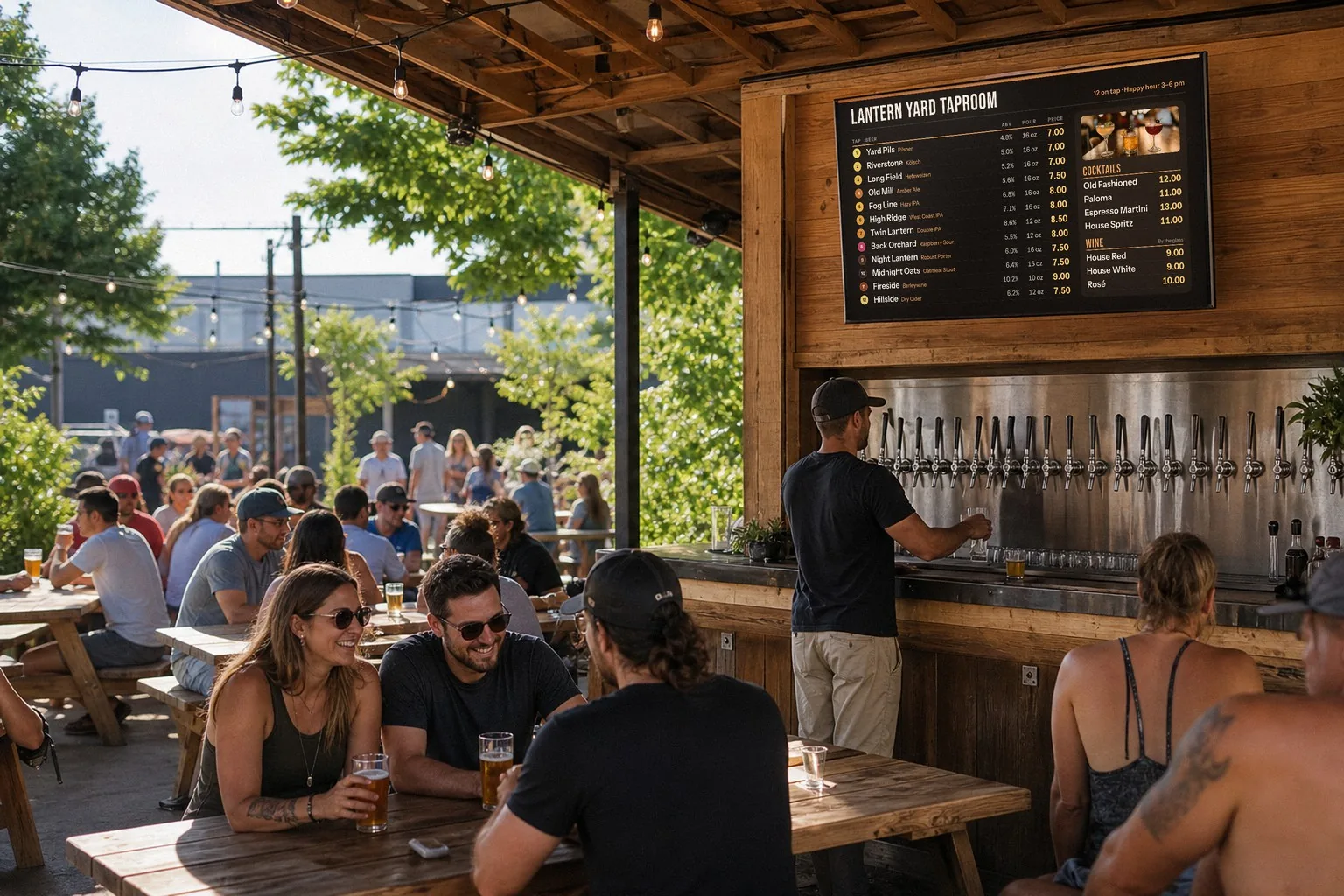
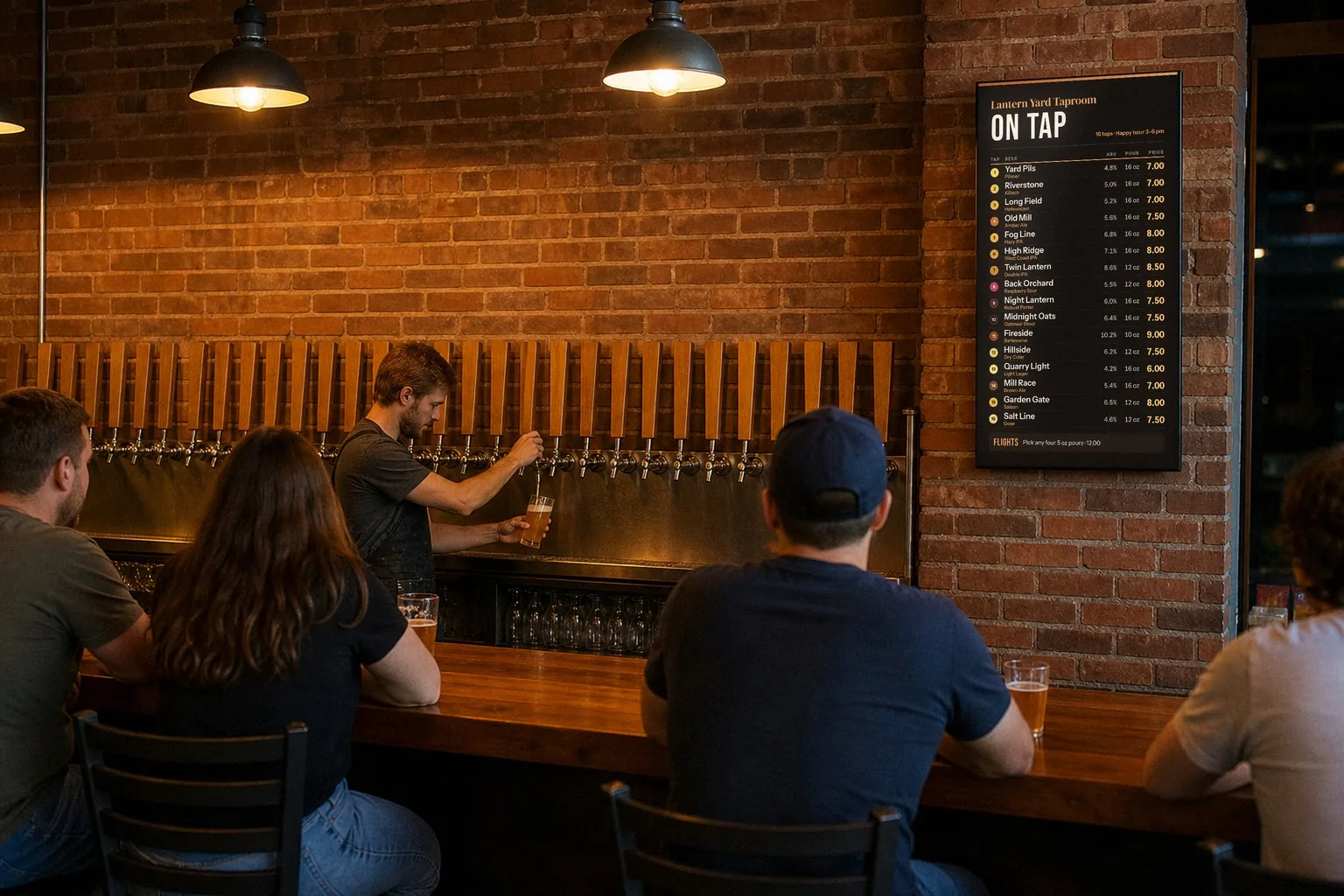
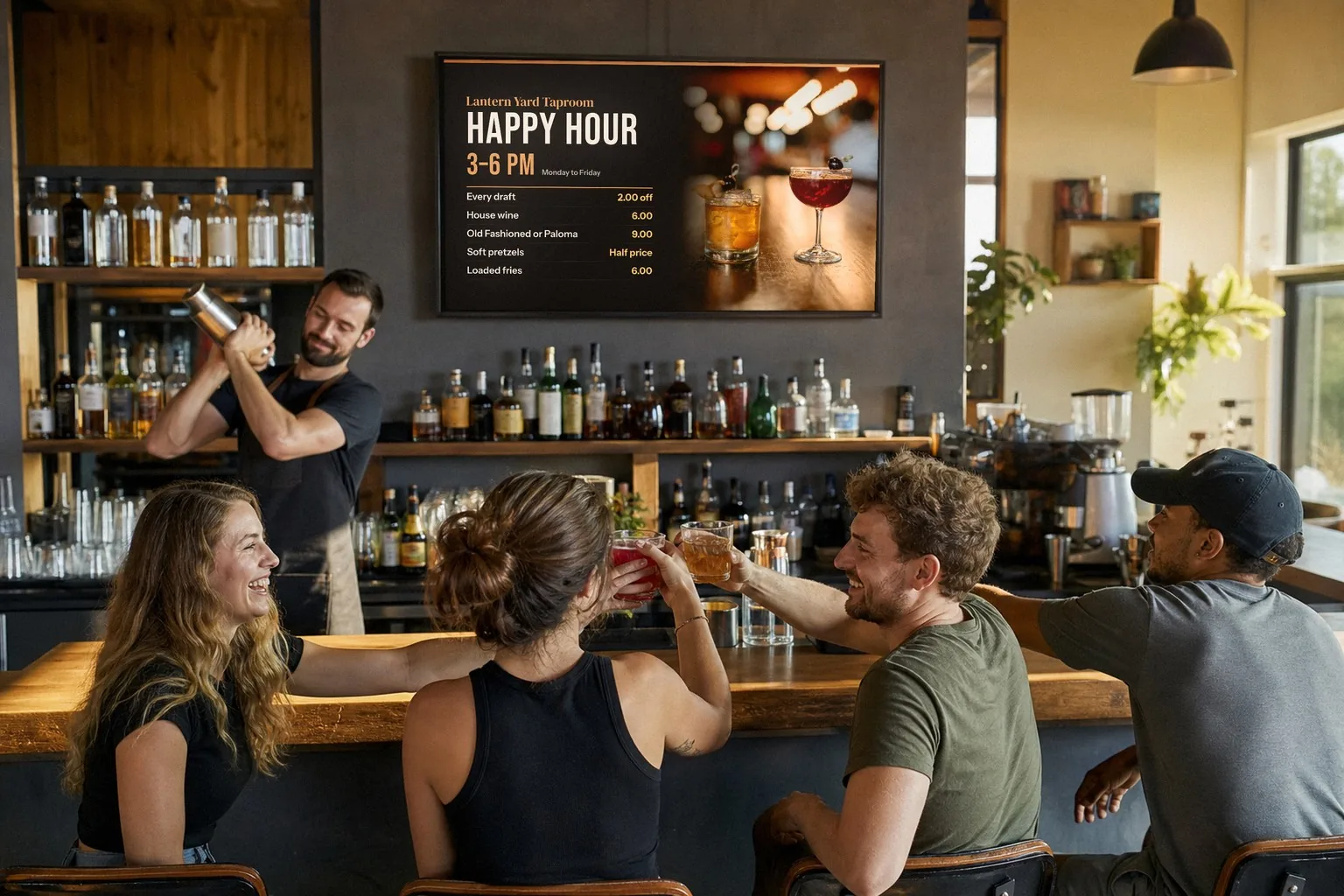
Draft beer, cocktails and wine on one board, with the pour size and price on every beer. The scene is staged; the board is a sample Just a Menu design.
- ✓Every pour, its own price: in Just a Menu, each pour is a size with its own price, so a 16 oz pint and a 10 oz pour sit on one line.
- ✓Happy hour on a schedule: give your happy hour slide its days and hours, and your TVs switch to it and back on their own.
- ✓Keg kicked? Tap Sold Out in Menu Workspace. The beer comes off your TVs and your QR menu, or shows as sold out. You choose which.
- ✓On Square, Toast, Oracle or Clover? Change a price in your POS, and your boards follow on their own.
Setting up the tap list itself? How to set up a digital beer menu board
Want to sell more drinks? How to increase beverage sales
Questions
How do you calculate pour cost?
Work out what one pour costs you, divide it by the drink’s menu price, and multiply by 100. Cost per pour is the bottle or keg cost times the pour size in ounces, divided by the ounces in the container. For example, a 1.5 oz pour from a 750 ml bottle (25.36 oz) that cost 24 dollars costs you about 1.42. Sold for 6 dollars, that’s a pour cost of about 23.7%.
What is a good pour cost?
It depends on your bar, your prices and your area. As a rule of thumb, many bars aim for roughly 15 to 25% on spirits and draft beer, a little more on bottled and canned beer, and roughly 20 to 35% on wine by the glass. Your own number, tracked over time, matters more than any benchmark.
How many pours are in a keg?
On paper, a half barrel (15.5 gallons, or 1,984 oz) holds 124 pints of 16 oz, or about 165 pours of 12 oz. A quarter barrel (992 oz) holds 62 pints, and a sixth barrel (about 661 oz) about 41. Foam, spills and line cleaning mean you’ll sell fewer than that.
How many shots are in a 750 ml bottle?
A 750 ml bottle holds 25.36 oz, so it has about 16.9 shots of 1.5 oz on paper. Count on 16 full shots. At a 1.25 oz pour it’s about 20, and at 1 oz about 25.
Illustration
POS integrations
Change a price in Square, Toast, Oracle or Clover, and your boards follow on their own.
See POS integrations →
Sample templates
Menu board templates
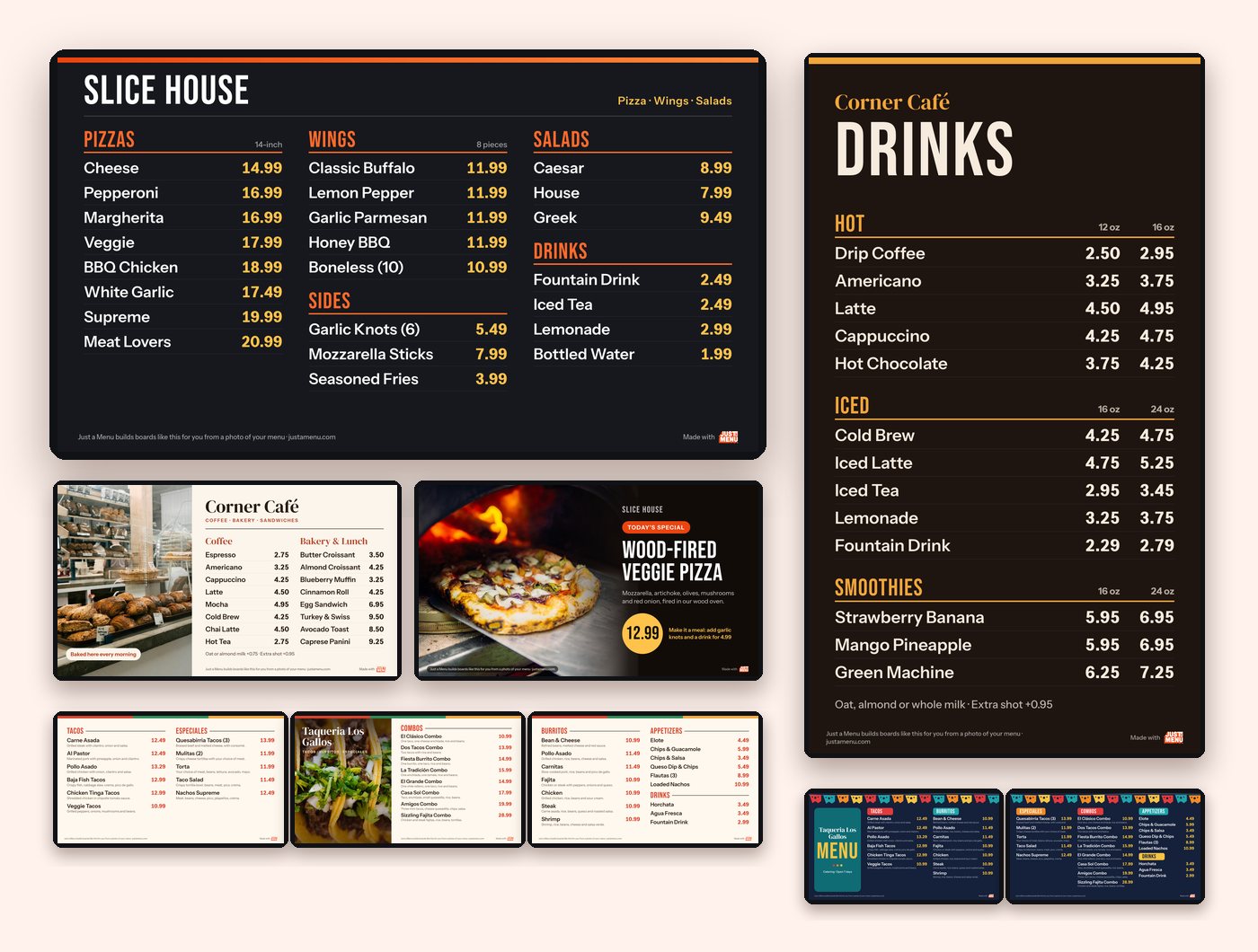
Layouts for one TV or a row, wide or tall, including a tall drinks board.
See the templates →
How to make a QR code menu
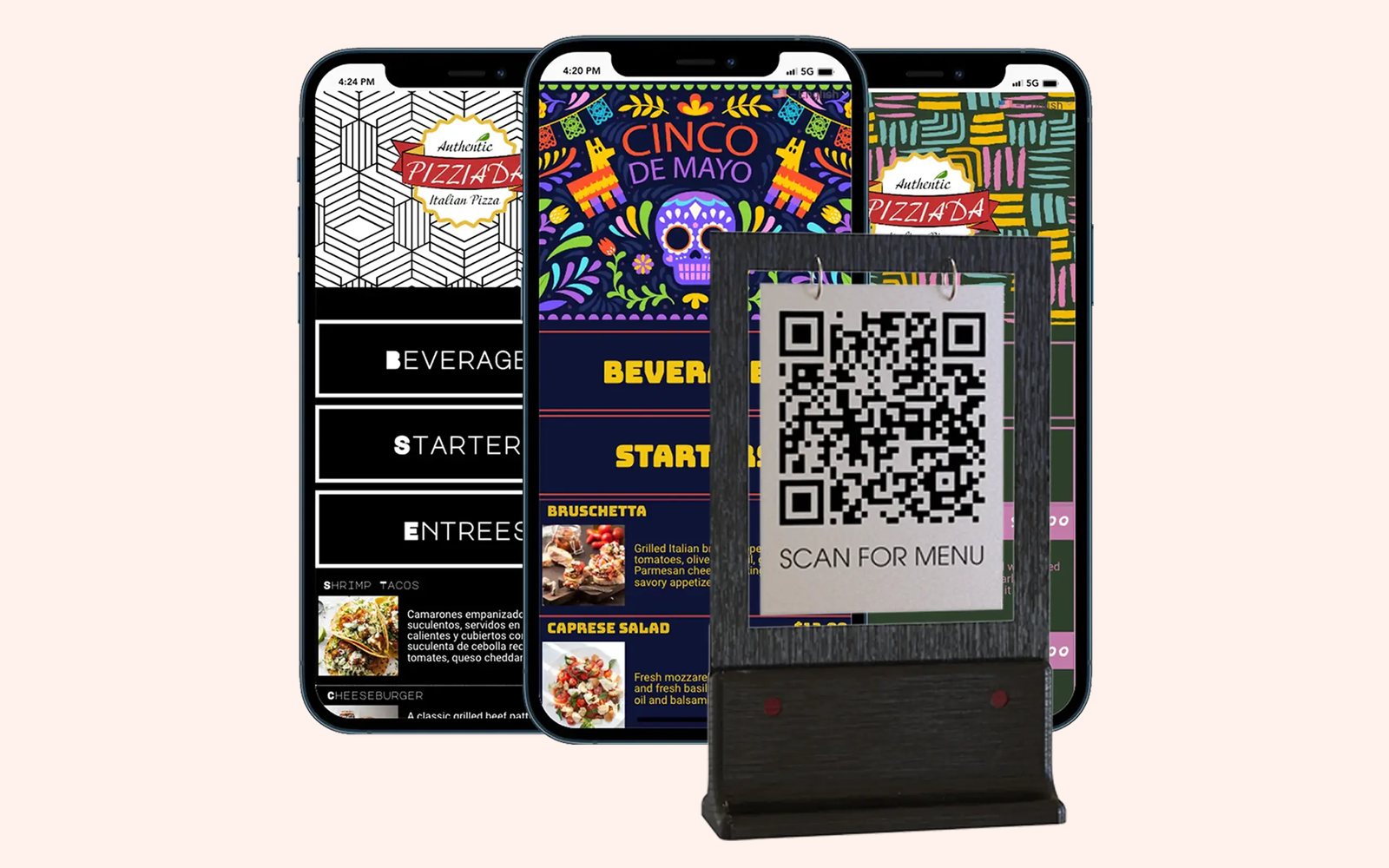
The same drink list as your TVs, on every guest’s phone. Print the code once.
Read the guide →
Priced your pours? Put them on your TVs.
Once you’re set up, snap a photo of your drink menu and Just a Menu builds finished boards for the TVs over your taps, plus the same menu on a QR code and in print.
Talk to a real person. We reply within one business day.
Illustration
Questions about your drink menu? Email support@justamenu.com or call (202) 886-2442.